

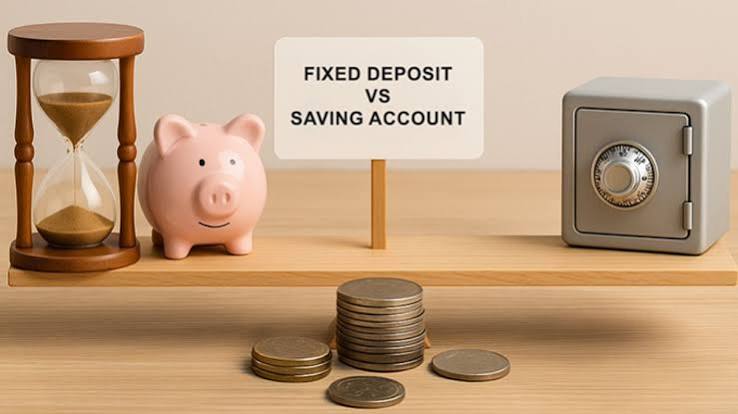
Financial discipline sounds like a personal trait. Something you either have or you don’t. But honestly? The reality is messier. Most people’s spending habits are shaped less by willpower and more by how easily they can get to their money. That’s exactly where the difference between fixed deposits and savings accounts starts to matter.
Both sit in the same bank. Both are safe. Both earn interest. But they behave in completely different ways when it comes to protecting you from your own impulses. If you’ve ever moved money from savings to UPI in thirty seconds flat for something you didn’t need, you already know which side of this divide you’re on.
Savings Accounts: Maximum Access, Minimum Friction
A savings account is built for liquidity. That’s its entire job. Money goes in, money comes out, no questions asked. UPI, debit card, NEFT, IMPS, ATM. Every channel open, every transaction instant.
For daily expenses and short-term cash flow, you need that access. Can’t function without it. But the same frictionless design that makes a savings account useful for bills also makes it terrible for protecting money you’re trying to set aside. Unlike fixed deposits, there’s no barrier between your balance and a late-night online purchase. No cooling-off period. No penalty for pulling money out.
And look, that’s not a flaw. It’s just what the product is. For anyone who struggles with impulse spending or finds it genuinely hard to watch a balance grow without touching it, a savings account offers zero structural help. None.
Fixed Deposits: Built-In Friction as a Feature
Fixed deposits work on a completely different logic. You commit a specific amount for a specific tenure. The money leaves your savings account and sits in a separate instrument you can’t access instantly. Breaking an FD early is possible, sure, but it comes with a penalty and a process. That friction is small. But it’s enough.
Here’s what most financial advice gets wrong about discipline. It’s not about motivation. It’s about architecture. When getting to your money requires an extra step- a deliberate choice to break a deposit, accept a penalty, wait for processing- you pause. That pause, tiny as it seems, is often the difference between an impulse purchase and leaving the money alone.
An FD forces that pause by design. You don’t need iron willpower. The product handles it for you.
Where the Two Actually Differ on Discipline
Factor
Savings Account
Fixed Deposits
Access Speed
Instant, multiple channels
Requires breaking the deposit
Spending Friction
None
Penalty and processing delay
Interest Incentive to Hold
Minimal, credited quarterly
Higher rate locked for full tenure
Psychological Commitment
Low, money feels “available”
High, money feels “committed”
Best For
Daily expenses, short-term cash
Goal-based savings, money you shouldn’t touch
That comparison makes the structural gap visible. Both hold your money safely. Only one makes it harder to spend on a whim.
The Laddering Approach: Discipline Without Rigidity
The usual objection to FDs is that locking everything away creates problems when you genuinely need cash. Fair enough. If you dump your entire surplus into one term deposit with a two-year tenure, yes, that’s rigid.
But laddering fixes that. Split your surplus across multiple FDs with staggered maturities. One coming due every three months, say. You always have something maturing within a reasonable window, so you’re never truly locked out. But between those dates, the money stays put. Untouchable.
Practical, flexible enough for real life, and it works especially well for people who know, honestly, that they need guardrails around their savings. No shame in that. Most people do.
Why the “Better Interest” Argument Misses the Point
Most comparisons between these two focus on interest rates. Bank deposits pay more than savings accounts; that’s the headline. But when the question is discipline, the rate is secondary.
The real value of fixed deposits for someone building savings discipline isn’t the extra interest. It’s the money that doesn’t vanish. A savings account balance that leaks slowly through small, forgettable transactions will often end up lower over a year than an FD that earned a modest rate but stayed completely intact.
Think about that for a second. The best return on your money is the money that’s still there when you actually need it.
Conclusion
If your problem is access and convenience, a savings account wins. If your problem is keeping money from quietly disappearing into everyday spending, an FD wins. The answer has less to do with which product pays more and everything to do with which problem you’re trying to solve. For most people who struggle to grow their savings, the friction of a term deposit isn’t a drawback. It’s the whole reason to use one.
