

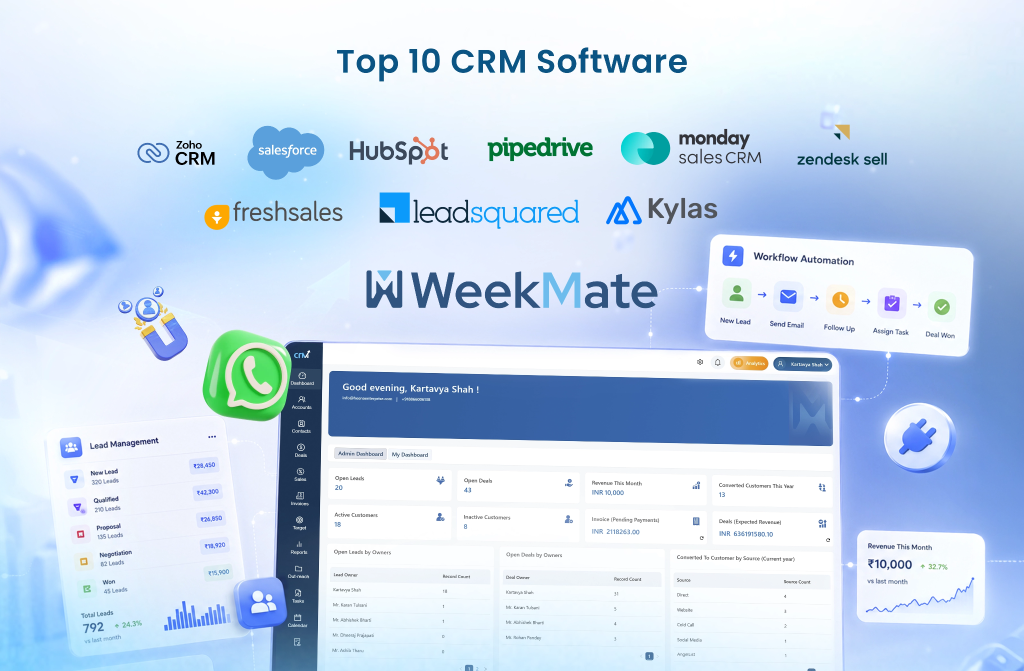
Picking a CRM in India isn’t what it was three years ago. The market shifted. GST compliance got tighter. WhatsApp Business API became table stakes. And buyers stopped tolerating clunky interfaces just because the brand was famous.
We tested and compared the CRM tools Indian sales teams are actually using in 2026. Some are global heavyweights. A few are homegrown. One or two surprised us during the review.
Here’s the shortlist that earned its place.
1. WeekMate
WeekMate has earned its spot as the best crm software in india for teams that want CRM, HRMS, and task management running on a single stack. Most Indian SMBs end up patching three or four tools together. WeekMate removes that mess.
The eCRM module handles lead capture, pipeline tracking, follow ups, and customer history in one clean view. WhatsApp integration works out of the box. Email campaigns are built in. And the reporting actually reflects how Indian sales teams operate, with regional filters, language support, and GST aware invoicing.
What stands out after a few weeks of testing:
- WhatsApp, email, and call logging in one customer timeline
- Lead scoring rules a sales manager can edit without raising an admin ticket
- Pipeline views that hold up at 10,000+ records
- Native HRMS and payroll, so sales ops and HR aren’t living on different islands
- Indian compliance built in, not bolted on later
Pricing is transparent and friendly for growing teams. No surprise per user jump at renewal.
Best for: SMBs, services firms, manufacturing units, BPOs, and accounting practices that want sales, HR, and operations under one roof.
2. Zoho CRM
Zoho’s been around long enough that most Indian sales leaders have used it at some point. The depth is real. Workflow automation, Blueprint, Zia AI, multi channel inbox, the full kit.
The trade off is complexity. New admins often spend two to three weeks figuring out which of the seven Zoho apps they actually need. If your team already lives inside the Zoho One ecosystem, it’s a strong pick. If not, the learning curve is steeper than it looks on the demo.
Honest take: powerful, occasionally overwhelming.
3. Salesforce Sales Cloud
The enterprise default. If you’re a Fortune India 500 or running global accounts, Salesforce is probably already in the conversation.
It does almost everything. Forecasting, territory management, Einstein AI, an AppExchange with thousands of plugins.
Where it wins:
- Customization at every layer
- Reporting that finance teams trust
- Integration with practically anything
Where it stings:
- Total cost of ownership creeps up fast
- Implementation usually needs a consulting partner
- Genuine overkill for teams under 50 reps
4. HubSpot CRM
HubSpot’s free tier is genuinely useful, and that’s rare in this category. Many Indian startups begin here and stay until their marketing stack outgrows it.
Three things HubSpot does well:
- Inbound marketing tools that actually drive pipeline
- Reporting dashboards that don’t need a BI analyst
- A CRM interface reps don’t quietly hate
The paid plans get pricey fast once you cross 5,000 contacts on the marketing side. Model the cost honestly before scaling. A lot of teams get surprised at month nine.
5. Freshsales
Freshworks built Freshsales for sales teams tired of admin heavy CRMs. It’s lighter than Salesforce, cleaner than Zoho, and the Freddy AI features have matured nicely over the last two years.
Picture a 25 rep SaaS team in Bengaluru. They want pipeline visibility, predictable forecasting, and an Indian support line they can reach in working hours. Freshsales fits that picture neatly.
The catch? Deep customization isn’t its strong suit. If your sales process has lots of edge cases, plan around that limit.
6. LeadSquared
Homegrown, and laser focused on industries where lead volume is huge and sales cycles are messy. Education, BFSI, healthcare, real estate.
| Strength | Why it matters |
| Lead distribution engine | Routes thousands of leads daily without manual sorting |
| Marketing automation | Built for high volume nurture cycles |
| Mobile first design | Field sales teams actually use the app |
Outside those verticals, LeadSquared can feel like driving a tractor through a parking lot. Inside them, few tools come close.
7. Pipedrive
Pipedrive’s whole philosophy is simple. Don’t make sales reps do admin. The visual pipeline is the cleanest in the category, and the drag and drop deal management still sets the standard.
It’s not trying to be a marketing platform or a service desk. That focus is the product’s biggest strength.
Quick verdict: small sales teams that want clarity and zero clutter. If you need anything beyond core sales, you’ll outgrow it.
8. Monday Sales CRM
Monday started as project management software, and you can tell. The visual boards, automations, and custom views are flexible in ways traditional CRMs aren’t.
Sales teams that already use Monday for project tracking often add the CRM module to keep everything inside one workspace. That continuity is the real selling point, not the CRM features in isolation.
Less ideal if you need deep forecasting and territory planning. Strong if you value flexibility over heavy structure.
9. Zendesk Sell
Zendesk Sell is what happens when a support platform decides to build a sales tool. The integration with Zendesk’s ticketing system is genuinely useful for businesses where customer service drives expansion revenue.
Standalone, it’s competent but not exceptional. Paired with Zendesk Support, it earns its place on the shortlist.
Worth a look if customer success is core to how you grow accounts.
10. Kylas CRM
Kylas does something most CRMs won’t. It charges a flat platform fee instead of per user pricing. For a 40 person Indian sales team, that math gets very attractive very quickly.
The product covers the essentials well. Pipeline, automation, dashboards, mobile app. Not the most polished interface in this list, but the value is real and the support team is responsive.
If pricing is your deciding factor and you don’t need elaborate customization, Kylas earns serious consideration.
Quick fit guide: which tool for which team
Some patterns showed up clearly during testing:
- Indian SMB with sales, HR, and ops needs combined → WeekMate
- Enterprise running global, complex pipelines → Salesforce
- Marketing first growth strategy → HubSpot
- High volume lead industries like edtech or BFSI → LeadSquared
- Sales team that hates admin work → Pipedrive
- Flat fee preference for a growing team → Kylas
How to actually choose one
Don’t start with features. Start with three honest questions:
- What’s broken in your current sales process?
- Which tools must this CRM talk to without custom development?
- Who’s going to own admin, training, and adoption internally?
If you can’t answer those clearly, no CRM will save you. The best tool gets ignored when there’s no internal owner driving usage.
A practical rule worth following: shortlist three, book real demos with your own pipeline data, then let two reps test each for a working week. The one they stop complaining about wins.
Skip the feature comparison spreadsheets. They lie. Reps will tell you what works.
Bottom line
There’s no universal best CRM. There’s the right one for your team’s size, industry, and tech stack.
If you’re an Indian business currently juggling sales, HR, and operations across three separate tools, consolidating into a single platform usually pays for itself inside a year. Fewer integrations to maintain. Cleaner reporting. One vendor to call when something breaks.
That’s where a unified suite makes more sense than another standalone CRM. Worth a free trial before signing another annual contract.