

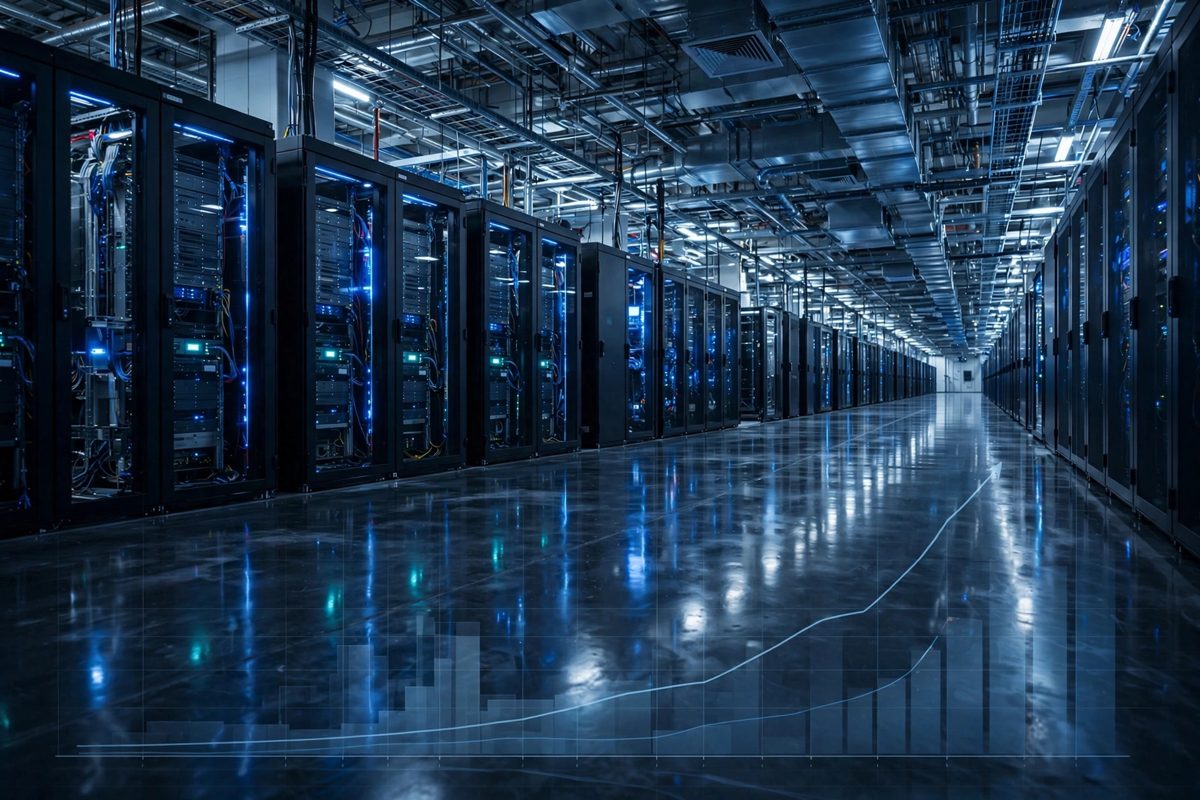
Artificial intelligence has triggered the largest technology building boom in a generation. Across the United States and beyond, cloud providers and their partners are pouring money into data centres, power connections, cooling systems and advanced chips. Yet a growing number of analysts are asking an uncomfortable question: is the spending growing faster than the revenue the new infrastructure can realistically generate?
That question matters far beyond the technology sector. Data centres now drive construction jobs, electricity demand, chip sales and a significant share of stock market gains. If the returns arrive more slowly than expected, the effects would be felt by investors, suppliers and entire regional economies.
The Scale of the Build-Out
The numbers involved are difficult to overstate. Industry forecasts for global data centre capital expenditure now run into the trillions of dollars over the coming years, covering everything from land and buildings to the specialised processors that train and run AI models. Each new facility requires years of planning, enormous amounts of power and supply chains that stretch from semiconductor fabrication plants to local electrical contractors.
The logic behind the spending is straightforward. Demand for AI services is rising quickly, and companies fear that falling behind competitors now would cost them far more later. That fear has turned capacity into a strategic asset: having servers available when customers want them is seen as essential, even if some of that capacity sits underused in the short term.
The build-out also reaches deep into the wider economy. As our coverage of how hardware partners move products from prototype to mass production shows, complex supply chains must scale in step, and bottlenecks in one component can delay an entire facility.
Revenue Is Arriving, but More Slowly
The concern raised in recent industry analysis, including reporting by The Register on forecasts that infrastructure spending will outstrip expected revenue, is one of timing. AI products are generating real and growing income, but the sums remain small compared with the capital being committed up front.
There is also a mismatch in how the money flows. Much of the spending happens immediately, while revenue depends on businesses and consumers adopting AI tools at scale and continuing to pay for them month after month. If adoption plateaus, or if competition pushes prices down, the gap between costs and income could widen rather than close.
Depreciation adds another layer of pressure. AI chips and servers lose value quickly as newer, faster generations arrive, so facilities must earn back their costs within a relatively short window. That makes utilisation rates — how busy the equipment actually is — one of the most important numbers in the industry.
What Investors Are Watching Now
For markets, the debate is not really about whether AI is useful. It is about valuation, debt and timing. Companies funding the build-out with borrowing face interest costs that do not wait for future revenue, and lenders are beginning to examine data centre projects more closely than they did during the first wave of enthusiasm.
Investors are also paying closer attention to the difference between announced spending and contracted demand. Facilities backed by long-term agreements with creditworthy customers look very different from speculative capacity built in the hope that demand will appear. Transparency on that split is becoming a key test of credibility for management teams.
Suppliers feel the swings first. As we have reported in coverage of how hardware businesses turn industry expertise into market reach, firms throughout the chain benefit when orders surge, but they also carry the risk if projects are delayed, resized or cancelled.
Why This Matters Beyond Technology
Data centres have become local economic events. They bring construction work, tax revenue and demand for skilled technicians, but they also raise questions about electricity prices, grid capacity and water use. Communities asked to host them increasingly want evidence that the long-term benefits justify the strain on local infrastructure.
Governments face a similar calculation. Many have welcomed AI investment as a sign of competitiveness, yet the public costs of grid upgrades and energy expansion are real. A slowdown in the sector would therefore be a policy issue as well as a market one.
The Bottom Line
None of this means the AI build-out is destined to disappoint. Previous technology waves, from railways to broadband, overspent in their early years and still left infrastructure that powered decades of growth. The facilities being built today may well prove essential.
But the arithmetic now deserves the attention it is getting. Spending is certain, immediate and enormous; revenue is promising, growing and less certain. For investors, businesses and policymakers alike, the next phase of the AI story will be decided less by announcements of new capacity and more by a simpler measure: how quickly that capacity starts paying for itself.
