

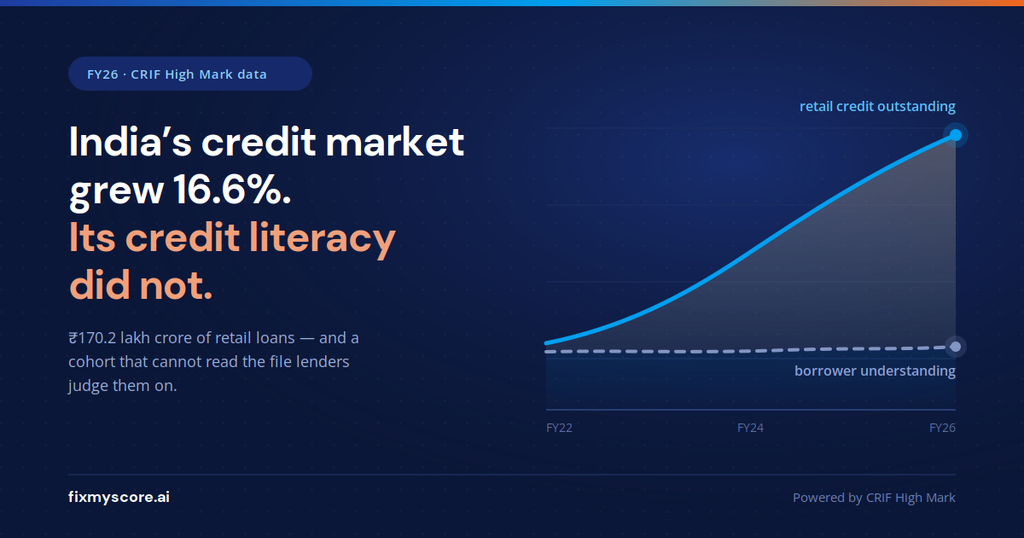
The headline numbers from India’s retail credit market look like an unambiguous success story. CRIF High Mark’s How India Lends report, with data as of March 2026, put total retail loans outstanding at ₹170.2 lakh crore, up 16.6% year-on-year. Consumption loans reached ₹118.6 lakh crore, up 15.3%. Gold loans grew 50.4% to ₹18.6 lakh crore. Delinquency trends improved across all top ten states.
Underneath the aggregate, a different pattern has been visible for two years running, and it is the one that matters for anyone trying to understand where Indian credit risk actually lives.
The stress is small, unsecured and new
Successive bureau reports have found the same asymmetry: large-ticket and secured lending performing well, while repayment behaviour deteriorates in loans under ₹1 lakh — small-ticket personal loans, two-wheeler finance, microcredit. CRIF High Mark’s earlier FY24-25 edition flagged sharply rising delinquency among subprime and new-to-credit customers in exactly these low-value categories, even as home, auto and higher-ticket personal loan originations grew. Lenders responded rationally: risk aversion tightened, credit policies were recalibrated, and the mix shifted toward collateral.
The word doing the heavy lifting there is new-to-credit. A new-to-credit borrower is someone with no prior bureau history — first job, first small loan, first BNPL line, often first formal financial product of any kind. India has added tens of millions of them over the last five years, which is genuinely the point of financial inclusion. But the sequence matters: their first credit product is typically the smallest and most expensive one available, taken at the moment they have the least information about how the system will remember it.
The structural issue is not that India lent too much. It is that a large cohort entered the credit system without any working understanding of the file that would follow them through it for the next seven years.
Three gaps, in ascending order of cost
Gap one: people track a number, not a file
A credit score is a three-digit summary. A credit report is the underlying record: every account, every status, every inquiry, every days-past-due marker. Lenders underwrite off the report. Consumers, almost universally, look at the score — which is where the free-score apps have trained attention, because a number is easy to display and a report is not.
The consequence is that borrowers discover problems late. An account wrongly marked overdue, a duplicate entry from a closed loan, a settled status on a loan the borrower believed was fully repaid — none of these announce themselves in the score until they have already done their work. This is the practical case for reading the account-level detail rather than the headline: borrowers can pull a full CRIF credit report free of charge and see the underlying entries as a lender does.
Gap two: people do not know what moves the number
The weightings are not secret. Payment history is the dominant factor, followed by credit utilisation, then length of history, credit mix and recent enquiries. Yet the most common behaviours we see among borrowers trying to improve their position are actively counterproductive:
- Closing the oldest credit card, which shortens average credit history and cuts total available limit, raising utilisation on what remains.
- Applying to five lenders in a fortnight after one rejection, generating a cluster of hard enquiries that reads as credit hunger.
- Paying only the minimum due on a card while carrying a balance near the limit — technically not a default, quietly corrosive to utilisation.
- Avoiding credit entirely after a bad experience, which produces a thin file that lenders cannot price and often decline outright.
None of these are irrational given what the borrower knows. They are rational responses to an incomplete model. The broader case for why this number governs so much of household financial cost is rarely made to people before they need it.
Gap three: people do not know they have rights
This is the most expensive gap, because the remedy already exists and is free.
Under the RBI’s framework for compensation for delayed updation or rectification of credit information, a borrower who files a dispute is entitled to ₹100 per calendar day where the complaint is not resolved within 30 calendar days of initial filing. The 30 days are split: credit institutions must transmit corrected information to bureaus within 21 days of being informed, leaving the balance to the bureau. Wrongful denial of compensation can be escalated to the RBI Ombudsman under the Integrated Ombudsman Scheme, 2021, or to the Reserve Bank’s Consumer Education and Protection Cell.
That framework has been in force since 2024. In our experience of Indian borrowers seeking help with damaged files, awareness of it is close to zero.
The clock just got faster
All of the above now operates on a shorter cycle. India moved from monthly bureau reporting to fortnightly on 1 January 2025, and from fortnightly to weekly incremental reporting on 1 July 2026 under the RBI’s amended Credit Information Reporting directions — weekly files covering what changed, plus a full file monthly.
For an informed borrower, this is straightforwardly good: repayments, cleared overdues and utilisation reductions surface in days rather than weeks, and improvement becomes visible inside the window in which the effort was made. For an uninformed one, it means errors and adverse events also reach every lender’s underwriting stack in days. Faster infrastructure amplifies whichever side of the literacy gap you happen to be on.
What actually closes the gap
There is a version of this argument that ends in a call for financial literacy campaigns. Those have a poor record, largely because generic education arrives untethered to any decision the person is currently making. What demonstrably works is narrower:
- Report-first, not score-first. Pull the full report quarterly and read the account section line by line. Checking your own file is a soft enquiry with no score impact.
- Verify statuses on every closed account. Confirm each reads Closed, not Settled or Written-off. This single check catches the most expensive category of error.
- Hold utilisation below 30% of total limit, measured across all cards, not per card.
- Space credit applications by at least three to six months, and check eligibility before applying rather than after rejection.
- Keep the oldest account alive, even at minimal usage, to protect history length.
- Dispute in writing, with a dated filing, and hold the 30-day clock. A practical walkthrough of the free routes to your report and score is available here.
Where the market goes next
For lenders, the direction of travel is already visible in the CRIF data: a tilt toward collateral, tighter policy on small-ticket unsecured lending, and sharper segmentation of new-to-credit applicants. That is prudent portfolio management, and it will hold.
The more interesting question is what happens on the consumer side. India now has a crowded field of apps showing people their score — a comparison of what the main Indian credit score apps actually do differently makes the sameness fairly obvious. Display is a solved problem. Explanation, error detection, and dispute workflow are not, and in a weekly-reporting regime they are where the value has moved.
India built the credit infrastructure first and is now retrofitting the comprehension layer on top of it. That order is not unusual — most markets did it the same way — but the retrofit is where the next decade of consumer fintech in this market will be won or lost.
Frequently asked questions
What does new-to-credit mean in India?
A new-to-credit borrower is someone with no prior credit history at any bureau — no loans, cards or credit lines previously reported. Because there is no repayment record to assess, lenders either decline or price such applicants conservatively, which is why a first credit product is usually small and expensive.
What is the difference between a credit score and a credit report?
The report is the full record: every account, status, payment history and enquiry. The score is a single number, typically 300–900, calculated from that record. Lenders read both, but underwriting decisions and adverse-entry reviews happen at the report level.
How often should I check my credit report?
Quarterly is a reasonable cadence now that lenders report weekly. Checking your own report is a soft enquiry and does not affect your score, so there is no downside to checking more often.
What compensation applies if a credit report error is not fixed?
Under the RBI framework, a complainant is entitled to ₹100 per calendar day where a dispute is not resolved within 30 calendar days of initial filing. Credit institutions must send corrected information to bureaus within 21 calendar days of being informed. Wrongful denial can be escalated to the RBI Ombudsman.
