

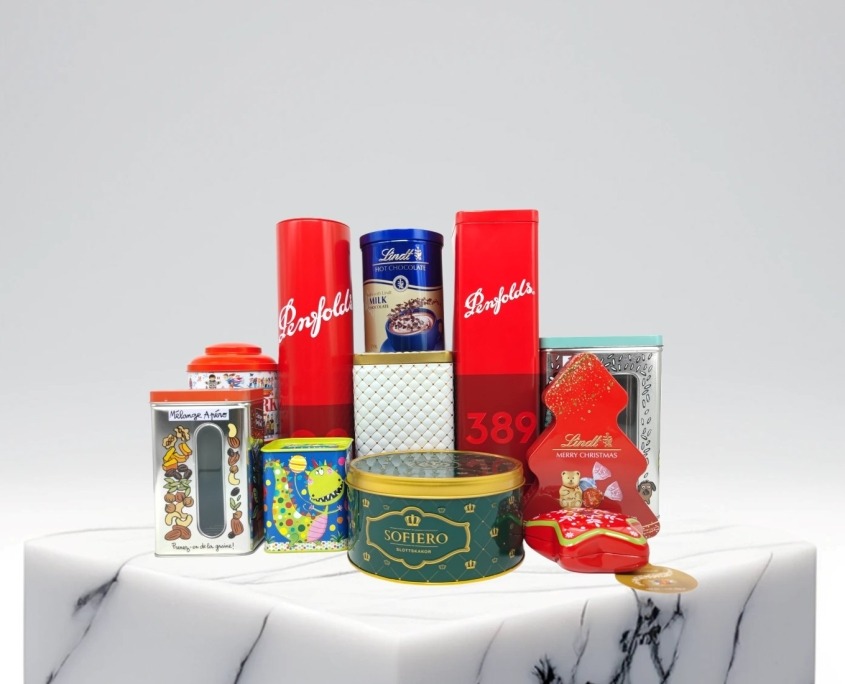
In the modern packaging world, shape is more than just a design factor; it’s a critical factor influencing production efficiency, material utilization, and even consumer perception of the product. For experienced tin can manufacturers, the shape of a tin not only determines the technical aspects of production but also impacts overall cost-effectiveness and brand appeal. During the manufacturing process, even slight variations in curvature or edge alignment can affect the quality of the material’s stamping, folding, and sealing.
Why Shape Matters to Every Tin Can Manufacturer
Any professional tin can manufacturer understands that shape determines process. While round cans may seem standard, modern packaging demands a variety of shapes, such as rectangular, square, oval, and even heart-shaped. Each shape requires different dies, stamping pressures, and sealing techniques.
For example, round cans are easier to produce at high speeds because their symmetry allows for continuous crimping and sealing. In contrast, rectangular cans require precise corner forming and additional dies to ensure a tight and uniform seam. As experienced tin can manufacturers, we understand that even slight deviations in die alignment can lead to inefficiencies or defects in the can. Beyond production, tin can shape also impacts storage, transportation, and end-user convenience. Round cans save space during machine handling but are less convenient when stacking in cartons; rectangular cans, on the other hand, improve pallet utilization.
How Tin Can Shape Affects Tooling, Material Usage, and Cost Efficiency
From a tin can manufacturer’s perspective, die accuracy and material usage are directly related to the can’s shape. Different shapes require unique stamping and forming dies. For example, round dies are cost-effective and easy to maintain, while irregular shapes require more complex die systems, increasing setup time and costs.
The geometry of the tin can also determine how efficiently the sheet metal is utilized. Round shapes generate the least scrap, while square or irregular contours may generate more scrap, depending on the nesting pattern. Experienced tin can manufacturers use CAD-based design planning to optimize material layout, minimizing scrap and lowering unit cost. Furthermore, certain shapes may require different metal thicknesses for strength, especially around corners or edges. To prevent deformation during production or shipping, reinforcing rings, crimps, or crimps may be necessary.
Tin Can Manufacturer Insight: Line Adaptability and Speed
From a tin can manufacturer’s perspective, one of the most valuable lessons is that production speed often depends on can shape. Standard round cans can be mass-produced on a continuous line at speeds up to 200 per minute. However, when producing custom-shaped cans, especially square or decorative designs, line speeds can drop significantly due to the increased forming and calibration steps.
Tin can manufacturers must frequently reconfigure forming, crimping, and sealing stations to accommodate different shapes. This impacts not only speed but also consistency. For example, non-round cans require more frequent calibration checks to ensure an even fit and seal on the lid. At Tsing, we utilize modular production lines that can adjust between standard and custom shapes, minimizing downtime and increasing flexibility while maintaining efficiency.
The Relationship Between Can Shape, Coating, and Printing Processes
For professional tin can manufacturers, the shape of the can also impact coating and printing operations—two steps that are critical to achieving a premium appearance. The flat surfaces of square or rectangular tin cans are easier to print with high registration accuracy, while the curved surfaces of round tin cans require precise printing alignment to prevent distortion.
Furthermore, the shape of the can impacts how the coating is applied. On irregularly shaped cans, varying spray angles can result in uneven coating thickness in certain areas, increasing the risk of long-term corrosion. To address this issue, experienced tin can manufacturers utilize electrostatic or rotary spray systems, which ensure uniform coating coverage even with complex geometries. From a branding perspective, shape and finish must be harmonious. Rectangular cans offer ample printable space, making them ideal for premium tea or coffee packaging, while cylindrical designs emphasize symmetry and a traditional aesthetic.
Practical Challenges Tin Can Manufacturer Face in Customizing Shapes
While customization offers unique brand differentiation, it also presents technical and logistical challenges that every can manufacturer must carefully navigate. One of the primary considerations is ensuring the new shape remains structurally stable during molding, sealing, and shipping. Another challenge lies in mold manufacturing. For custom tin cans, developing a specialized mold, testing its accuracy, and optimizing molding parameters can take weeks. This process requires advanced equipment and experienced technicians who can transform design concepts into manufacturable solutions.
From the tin can manufacturer’s perspective, even the slightest shape variation can result in a mismatched seal or uneven bead, especially when transitioning between production batches. To address this issue, Tsing integrates 3D simulation technology to analyze material flow and deformation before production, minimizing trial runs and ensuring flawless results.
The Innovative Shape of Modern Tin Can Manufacturing
In today’s competitive packaging market, shape has evolved into a strategic design element, influencing everything from production efficiency to consumer engagement. For professional tin can manufacturers, understanding the engineering, aesthetic, and practical implications of can shape is crucial to achieving consistent quality and manufacturing excellence. Whether you’re designing for luxury packaging or mass-market products, with the guidance of an experienced tin can manufacturer, the right shape can determine your brand’s success in a crowded market.