

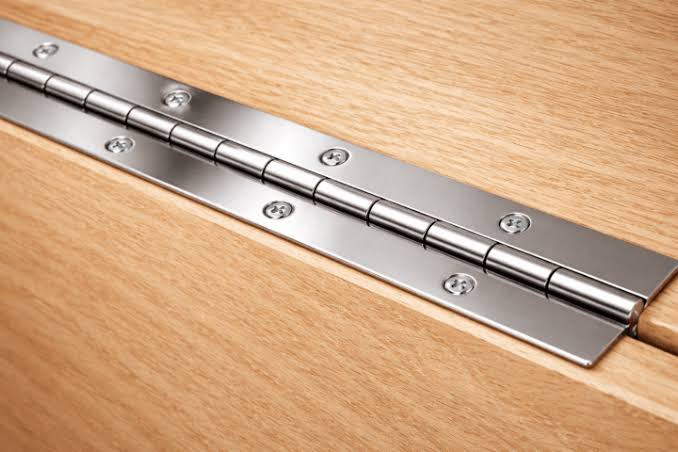
Doors, lids, covers, access panels, cabinets, and equipment enclosures often require hinges that can withstand repeated opening and closing. In many commercial and industrial applications, conventional hinges positioned at a few points may not provide the level of continuous support required. Piano Hinges offer an alternative by extending along a significant portion of the connected surfaces, helping distribute movement and load more evenly.
For manufacturers, fabricators, maintenance teams, and businesses involved in industrial equipment, choosing an appropriate continuous hinge requires careful consideration of material, dimensions, installation, and operating conditions.
Understanding Continuous Hinges
Piano hinges are long hinges consisting of two leaves joined by a central pin. They can be manufactured in various lengths and materials and may be cut or specified according to the requirements of a particular application, subject to the manufacturer’s recommendations.
The defining characteristic of a piano hinge is its continuous construction. Rather than relying on two or three separate hinge points, it provides a connection along much of the panel’s length.
This can be useful for long or relatively heavy doors and covers where additional support is desirable.
Where Are Piano Hinges Used?
The versatility of Piano Hinges makes them suitable for many applications. They can be found on toolboxes, cabinets, storage compartments, machinery covers, electrical enclosures, access doors, and fabricated equipment.
Transport and automotive-related equipment can also incorporate continuous hinges into storage compartments and access panels.
In workshops and manufacturing facilities, these hinges can be particularly useful for equipment that requires regular access for servicing, cleaning, inspection, or maintenance.
Important Selection Factors
Choosing the right hinge begins with understanding the application. The dimensions and weight of the door or panel should be considered, along with how frequently it will be opened and closed.
The hinge material is another important factor. Indoor equipment may have different requirements from outdoor machinery exposed to rain, humidity, or contaminants.
Businesses should also consider the thickness of the hinge leaves, pin diameter, available mounting space, and the type of fasteners required.
Selecting a hinge that matches the application can help reduce unnecessary stress and support smoother operation.
Why Installation Matters
Even a high-quality hinge may perform poorly if it is incorrectly installed. The two surfaces being connected should be properly aligned before the hinge is secured.
Mounting holes should be positioned accurately, and suitable fasteners should be selected according to the material and expected loads.
The hinge should also be checked after installation to ensure that the door or panel opens and closes without excessive resistance or misalignment.
For larger industrial applications, installation procedures should follow the equipment manufacturer’s recommendations.
Maintenance for Longer Service
Regular inspection can help identify problems before they affect the operation of the equipment. Businesses should look for signs of corrosion, loose fasteners, bent leaves, damaged pins, or unusual movement.
If the hinge becomes difficult to operate, the cause should be investigated rather than forcing the panel open or closed.
Cleaning the hinge and surrounding area can also help prevent dirt and debris from interfering with movement.
Finding a Suitable Industrial Supplier
When sourcing Piano Hinges, businesses can benefit from working with an industrial supplier familiar with different hardware applications. Schutts Industrial supplies industrial hardware and components for a variety of commercial and manufacturing requirements.
Customers should provide details about the application, panel dimensions, material, expected load, environmental conditions, and frequency of operation when discussing hinge requirements.
This information can help identify a hinge that is more closely suited to the intended application.
Conclusion
The continuous design of Piano Hinges makes them a useful option for doors, panels, cabinets, machinery, and equipment that require consistent hinge support. Their ability to extend along a large section of a panel can help provide stability and controlled movement.
For commercial and industrial applications, choosing the right material, dimensions, installation method, and maintenance approach is important. Businesses looking for dependable industrial hinge solutions can explore suitable options through Schutts Industrial.